A cooling tower is a type of energy converter responsible for producing cool water for industrial machines. This tower acts as a large heat exchanger between water and air. The main purpose of this tower is to reduce the return water temperature from equipment such as chillers, boilers and metal melting furnaces. By creating an evaporation process, the water temperature decreases to a certain extent. Using a liquid like water, this equipment absorbs the excess heat of the machinery and directs it to the appropriate environment.
In the cooling tower, the heat is absorbed from the industrial components and transferred to the outside by dry air. In other words, this tower is a type of energy exchanger between water and air. In the cooling tower, contact and communication between two fluids, i.e. water and air, causes the transfer of heat energy and the reduction of water temperature. This process is highly dependent on the climatic conditions of the place where the cooling tower is installed, and the temperature of hot water in this tower is adjusted in a variable way in the surrounding environment.
Many industrial and non-industrial equipments heat up over time during their working cycle. A small part of these machines or equipment transfer the produced heat to the surroundings through exchange with the ambient air. Many of these equipments also use circulating water to dispose of their excess heat. The water that absorbs the heat of these devices, its temperature increases and is directed to the heat exchangers. For this reason, the cold water produced by the cooling tower completely dissipates this heat energy.
First user:
Heat dissipation of various industrial devices in all seasons, most industrial machines such as induction and arc furnaces, boilers and turbines produce a lot of heat during their working periods. By completing this industrial cycle, the cooling tower performs the process of absorbing this thermal energy and disposing it to the desired environment. Various industries, including gas turbines in refineries, air compressors in power plants, and steam boilers in various industries use this equipment as one of the most basic tools for heat removal.
In this usage model, the main task of the cooling tower is to extract heating energy from air without ambient humidity. The air exiting from the throat of the tower by increasing the humidity ratio causes the air exiting the tower to become saturated. These vapors in the air will mainly cause the formation of clouds and fog in the upper part of the cooling tower.
Second user:
In order to increase the uniqueness, most residential buildings, apartments, offices, banks and shopping centers are equipped with central ventilation system. In central cooling systems, compression or absorption chillers are used to cool the indoor air. The heat absorbed from a building area by the chiller increases the temperature of the refrigerant (compressor gas).
The cold water produced from the tower in the condenser section of the chiller compensates for the increase in the temperature of the refrigerant. It should be noted that only chillers with water condensers use a cooling tower in their condenser circuit. We must remember this important point that most compression and absorption chillers have a water condenser.
The heat energy that is rejected to the surrounding environment in the cooling towers causes cooling of the cooling fluid, and for this reason, the cooling tower can be considered as a type of industrial cooler. Energy transfer in the cooling tower is done by the latent heat of evaporation of the cooling fluid, for this reason, a small percentage of the circulating fluid volume is evaporated and then transferred to the outside air.
The cooling fluid must have the ability to receive a significant amount of energy in its circulation in an exothermic cycle and in passing through the cooling tower. In fact, the ability to receive energy in the cooling fluid is known as the specific heat capacity, and the best fluid in the cooling operation in an industrial cycle is water.
The mass transfer of vapors resulting from evaporation in the cooling tower, if the circulating fluid is water, increases the relative humidity of the surrounding environment and eventually forms fog. Therefore, it is always recommended to install the cooling tower in the outside environment so that the air inside the environment is not saturated over time and the final performance of the tower does not face a drop.
The dimensions of the cooling towers are actually the main factor for creating the energy exchange level. The larger the cooling tower, the larger the cross-sectional area will be, which will eventually transfer more heat.
The dimensions and size of the cooling tower have a direct effect on the cooling capacity or cooling power, in a way that larger towers will have more capacity. Today, in power plants as well as refineries and industries, it is easy to use large concrete samples with a strong structure to cool a very large volume of water per hour. For example, giant cooling towers measuring approximately 100 x 100 meters are used in these industries, while smaller cooling towers are used in industries such as plastic injection, rosin extraction, and sweat extraction.
Each of the introduced models can be made in the following materials.
A natural or atmospheric flow cooling tower, without the need for a propeller, uses water spray entirely and uses no components to circulate the air. In this type of tower, water is only sprayed and air flows naturally inside the tower.
These towers are known as a very economical option, but their performance is usually not stable and they are highly affected by wind and weather conditions. The shape of the simple atmospheric cooling tower represents this type of tower where water is distributed through nozzles and at the same time, air flows naturally inside the tower.
A mechanical flow cooling tower consists of one or more propellers that are used to circulate air. This type of cooling device has stable performance and is less affected by wind and environmental conditions.
In this type of cooling tower, a fan is used as a driver to create air flow. The air enters from both sides of the device and is directed upwards by the fan.
Mechanical flow cooling tower has unique advantages:
1. Very small structure: it has small physical dimensions that improve the possibility of installation and use in limited spaces.
2. Occupying a small space: due to its small dimensions, it does not require a lot of space for installation and deployment, and it enables use in limited places.
3. High efficiency and performance: By using mechanical flow and advanced tools, it provides high efficiency and optimal performance, which is used in converting heat to cool water.
4. Stability to weather conditions: Due to its unique design and mechanical features, it maintains its stability and efficiency against changes in weather conditions.
Mechanical flow induced draft cooling tower has the following advantages, especially due to its unique features:
1. Innovative design: This cooling tower, having a propeller or propellers in the air outlet section, makes good use of turbulence and increasing the speed of air exit in the fan area. This innovative design improves the efficiency and performance of the tower.
2. Preventing the propeller from freezing: By placing the propeller in the hot air outlet, this tower prevents the problem of the propeller freezing in cold seasons, which helps the durability and longer life of the cooling tower.
3. No air recirculation: In this type of cooling tower, the lack of air recirculation ensures that the air leaves the tower in a direct flow as much as possible and has better efficiency.
4. Compatibility with small dimensions: Due to their small dimensions, these models can be easily installed in limited spaces and bring optimal performance in limited spaces.
The mixed flow cooling tower is a unique combination of cooling towers that has exceptional features in its design and operation:
1. Compatibility with natural flow cooling towers: This cooling tower is designed with a similar appearance to a natural flow cooling tower, but with less elevation. Propellers are used to circulate the air and this point is evident from its innovative design.
2. Intelligent control of energy consumption: The design of the mixed flow cooling tower is such that in the cold season, the propellers can be automatically turned off and the fans can be used only in the conditions of higher heat or different load. This feature saves a lot of energy.
3. Flexible application: The mixed flow cooling tower has high flexibility in temperature and load management due to the ability to adjust the speed of propellers and also fans. When needed, it is possible to optimize the speed of propellers and fans.
4. Air management without creating turbulence: using propellers in the air outlet section, prevents the creation of turbulence and improves air management. This feature increases the efficiency and performance of the cooling tower.
Based on the appearance and geometry of the cooling tower, this equipment is divided into cubic cooling towers, circular (conical) cooling towers, and hexagonal cooling towers.
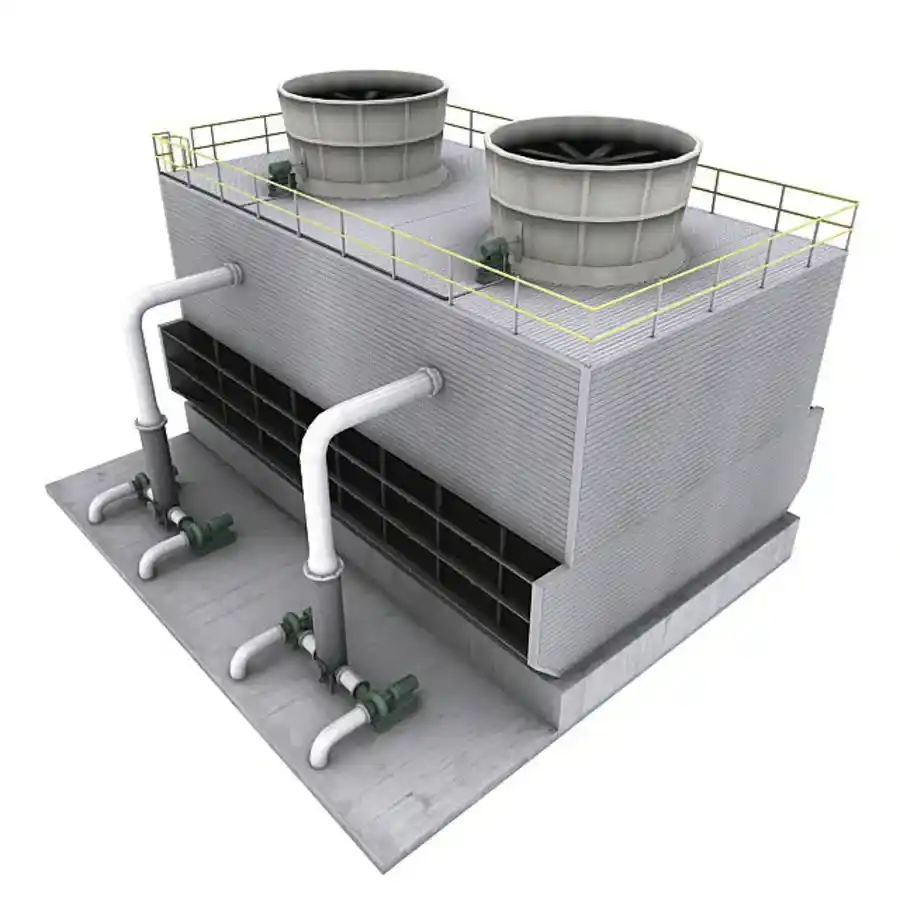
Cubic Cooling Tower is a structure with a unique appearance that works by means of water spraying system of fixed nozzles and induction suction aeration system. This type of cooling tower is designed in the form of a cube and due to this unique design and low space occupation, it is widely used in industry and air conditioning systems.
In a cubic cooling tower, water is sprayed from fixed nozzles and transferred to the cooling surfaces. Here, the water is in contact with the air and its heat is transferred to the air. Then the cooled water is transferred to the return system. The cubic cooling tower is considered as an effective option for coolers in limited environments due to the possibility of multi-cell production and occupying little space. By integrating the water spray system and induction suction aeration, this structure helps to improve the cooling efficiency and reduce the water temperature.
Circular or conical cooling tower is one of the most common types of cooling tower with circular and circular water spraying system. These towers have a cylindrical or circular appearance and are used in the cooling of compression chillers in apartments and industrial systems with low water circulation.
This type of cooling tower allows the water that enters it from the chiller or other heating systems to be cooled in contact with the air and then returned to the heating device by spraying water in a circle. The conical model is chosen in some cooling systems due to its use in places with low water circulation and the need for less space.
This type of cooling tower, a cooling tower with a limited design life, appears in the form of a hexagon, which is completely out of the category of cooling towers due to its many problems and disadvantages. The lack of proper water distribution, the creation of air holes in the corners of the hexagons and poor efficiency are among the main reasons for this decision to remove the production of this type of cooling tower.
Cooling towers according to the type of material and also the material used in the body are divided into fiberglass cooling tower, concrete cooling tower and metal cooling tower.
Due to the significant growth of the industry in the last few decades and the increasing need for cooling energy sources in industries, concrete and metal cooling towers have experienced various disadvantages compared to fiberglass cooling types in the past decades. In the following, we will mention some of the weaknesses of the cooling towers in the past.
In the cooling process of industrial water, which includes very high hardness, galvanized cooling towers faced problems such as sedimentation, clogging, and rotting in the body due to the presence of many salts in the water. Among the distinctive features of the fiberglass cooling tower is the absence of corrosion and rotting, and this advantage is due to the special type of fibers used, wicker and needle, along with unsaturated polyester resins, which gives the cooling tower strength and resistance. Also, adding one or more layers of epoxy resin in the end wall of the tower provides more resistance to the effects of sunlight.
Fiberglass cooling tower allows for easy repairs due to its lighter weight, bolt and nut connections where its components are individually and accurately connected to each other.
One of the common types of cooling towers in the industry, especially in thermal power plants for cooling the steam of gas turbines, is a concrete cooling tower with a hyperbolic structure (in the form of a narrow-waisted cylinder), which is designed in two types of natural flow and induced flow. This type of cooling tower in natural flow mode is also known as atmospheric cooling tower.
The use of concrete structures with huge dimensions in the structure of cooling towers has caused many problems. Today, cooling system designers often do not use any of the concrete cooling tower types in their proposals due to potential problems.
Currently, due to space limitations in some factories and industrial units, galvanized cooling towers are more widely used. This tendency to use galvanized cooling towers is due to various factors, and one of these factors is the common use of low-noise spiral fans in the structure of these types of cooling towers.
One to four centrifugal fans are used in the galvanized cooling tower to create the necessary refrigeration for cooling and to achieve high efficiency.
One of the advantages of the galvanized cooling tower is its small size, which is especially beneficial in limited spaces. However, it should be noted that despite the advantages, this type of cooling tower also has many disadvantages. One of its biggest disadvantages is the formation of deposits, corrosion and the growth of various biological microbes on the wall and inside the device. Also, the conductivity of metal against heat penetration is also a fundamental defect, which will have a significant negative effect on the cooling tower outlet temperature in hot seasons.
Open-circuit cooling tower is divided into two categories, asymmetric flow cooling tower (opposite flow cooling tower) and vertical flow cooling tower (cross flow cooling tower) according to the way fresh air enters and the angle between the suction air flow and the falling water flow.
Counterflow or counter flow cooling tower is one of the types of open circuit cooling tower where the air suction or blown flow flows in the opposite direction of the falling or spraying water flow. These towers are divided into two categories, cubic and circular, based on their appearance. This type of cooling tower is mostly used in areas with hot and dry climates, and in these areas it provides the highest temperature drop and efficiency.
Due to the high efficiency of this type of cooling towers in hot and dry regions, they are used in many central regions of the country that have hot and dry climates (such as Yazd, Isfahan, Tehran, Mashhad, Arak, Zanjan, Qazvin, etc.). are widely used.
One of the advantages of the galvanized cooling tower is its small size, which is especially beneficial in limited spaces. However, it should be noted that despite the advantages, this type of cooling tower also has many disadvantages. One of its biggest disadvantages is the formation of deposits, corrosion and the growth of various biological microbes on the wall and inside the device. Also, the conductivity of metal against heat penetration is also a fundamental defect, which will have a significant negative effect on the cooling tower outlet temperature in hot seasons.
In recent years, cross-flow cooling towers have been widely used in industrial areas with high humidity. Areas such as the north and south of the country, which are near the sea and their air has a lot of humidity, greatly welcome this type of cooling towers.
The water cooling tower is divided into two general categories based on the type of cooling device. If the device that the cooling tower is responsible for cooling is in air conditioning systems (chiller), in this application it is called a cooling tower or cooling tower chiller. If the device that the cooling tower is responsible for cooling is different from other devices in the industrial cycle, it is called an industrial cooling tower.
Chiller cooling towers are one of the common equipment in building ventilation and chiller cooling systems. A chiller is a type of water cooler that cools water by creating a cycle in a gaseous fluid (refrigerant). Now, the heat that the chiller receives from the refrigerant must be transferred to the outside environment by another device.
The cooling tower of the chiller transfers the excess heat of the chiller to the surrounding environment, and it is also called the “cooling tower of the chiller”. This cold water tower supplies the condenser circuit (refrigerant cooling exchanger) and directs the heat to the outside by the mechanical flow of air. Therefore, the cooling tower chiller is considered as a forced flow cooling tower.
The industrial cooling tower is installed in the outdoor space of factories and industrial workshops and provides cold water needed by industrial devices. In this case, the cooling tower is considered as a large industrial water cooler, and for this reason, it is called “industrial cooling tower” or “industrial cooler” in the industry.
Heat-generating devices in cement, steel, oil and petrochemical factories, as well as all food production factories, need cooling and use cooling towers as a source to provide cool water. Considering the importance of this device in the industry, a lot of money is spent on its design and production. For this reason, it is recommended that you contact reputable companies like Demagaster regarding your cooling needs to find the best solutions and equipment for your specific needs.
Cooling towers are divided into two general categories, single-cell and multi-cell, based on the number of cells. The number of cells plays an important role in the design and performance of this equipment. The main reason for designing multi-cell cooling towers is to control better energy consumption and reduce the dimensions of the device. Also, these equipments are assembled in the factory, which reduces assembly costs at the project site.
In capacities higher than 500 tons of refrigeration, multi-cell cooling towers are used for water cooling. These devices operate as an integrated unit by using a larger number of cells and hence have the advantages of better control and higher efficiency in energy consumption.
Cooling towers are divided into two general categories, single-cell and multi-cell, based on the number of cells. The number of cells plays an important role in the design and performance of this equipment. The main reason for designing multi-cell cooling towers is to control better energy consumption and reduce the dimensions of the device. Also, these equipments are assembled in the factory, which reduces assembly costs at the project site.
In capacities higher than 500 tons of refrigeration, multi-cell cooling towers are used for water cooling. These devices operate as an integrated unit by using a larger number of cells and hence have the advantages of better control and higher efficiency in energy consumption.
Single-cell cooling systems are the most common and widely used types. The most common application of single-cell cooling towers is related to capacities lower than 500 tons of refrigeration. If the desired cooling capacity is calculated to be higher than 500 cooling tons, it is recommended to use modular (connected) or non-modular (separate) multi-cell cooling towers.
As an important point, the use of non-modular cooling towers requires more space for installation. This is the need to observe the distance between two cooling tower devices at the installation site, which is the standard distance between two single-cell cooling tower devices, which is generally considered to be twice the height of the louver or air intake shutter. This distance increases the space required for installing non-modular multi-cell cooling towers.
Multi-cell cooling towers are used in high refrigerating capacities where it is not possible to produce a cooling tower with homogeneous dimensions with a square cross section or due to the increase in the width of the device and the impossibility of loading. The use of multi-cell cooling towers leads to a reduction in assembly costs and the costs of loading and shipping goods. In addition, the use of multi-cell cooling towers can increase control over the amount of electricity consumption; For example, by turning off one or more cells in cold seasons.
These days, with the increasing interest of consumers in central air conditioning systems, especially chillers, choosing a cooling tower with the right capacity has become very important. If the capacity of the cooling tower is less than the required capacity of the chiller, in addition to reducing the efficiency of the building’s cooling system, it can cause irreparable damage to the system. Before choosing and calculating the cooling tower capacity, we need to get acquainted with some important parameters in this field.
1. Circulating water flow rate: Circulating water flow rate refers to the amount of water that is circulated by the pump in the cooling tower. To calculate the circulating water flow rate, the water speed is considered in meters per second and is considered between 2.5 and 3, and then it is multiplied by the cross-sectional area of the water inlet pipe to the cooling tower (in square meters) and the circulating water flow rate , is obtained in terms of cubic meters per second.
2. Geographical area: One of the important things in calculating the cooling tower capacity formula is the geographical area. The temperature and relative humidity of the air in the area where the cooling tower is installed is important. To calculate the capacity of the cooling tower, the ambient air temperature and relative humidity are considered. The higher the air temperature, the tower capacity must be increased to provide the required temperature difference of the system. Also, the higher the humidity of the environment, the more capacity is needed for evaporation.
3. Temperature difference: This parameter indicates the required temperature difference of the system that must be created by the cooling tower. This is the temperature difference of the water that enters the cooling tower from the condenser and then leaves it. Usually, the standard value for this temperature difference is 10 degrees Fahrenheit or 5 degrees Celsius.
The calculation of the cooling tower’s thermal capacity is obtained through appropriate formulas and considering these parameters.
Currently, due to the different coefficient of performance in the cooling towers of absorption and compression chillers (in absorption chillers the coefficient of performance is less than 1 and in compression chillers is close to 3), after the above calculations, to ensure the proper performance of the system, the number Multiply the result by 2 for absorption chillers and by 1.3 for the cooling tower of compression chillers.
In choosing the type of cooling tower, the following should be considered:
1. Type of cooling tower: which cooling towers, spherical or cubic, can be used?
2. Aeration rate: Cubic cooling towers use powerful 6- and 8-blade fans that provide at least 50% more aeration. In contrast, spherical cooling towers use weaker fans with 4 blades.
3. Water loss: Water loss is more in cubic cooling towers due to the absence of drippers.
4. Electromotor speed reduction system: In cubic cooling towers, belts are not used for power transmission, which increases performance and reduces the risk of belt failure and decay.
5. Efficiency: In cubic cooling towers, the air flow velocity is usually up to 1.8 m/s, while in spherical cooling towers it reaches 3 m/s.
6. Water distribution: In cubic cooling towers, a sprinkler system is used to cool the packings, while in spherical cooling towers, there is water raining on the packings, which improves water distribution and reduces problems.
7. Body: Cubic cooling towers use maximum body design with few joints due to being monolithic, resulting in greater strength and durability.
Due to the mentioned differences, cubic cooling towers have a noticeable and significant advantage over conical cooling towers. Therefore, our recommendation is to use cube cooling towers, however it should not be forgotten that cube cooling towers cost more than conical ones.
The price of the cooling tower, like other industrial devices, depends on several parameters and indicators. It should be kept in mind that the cost of using a cooling tower is not only the cost of purchasing it, but also includes other side costs such as the cost of piping design and implementation, the cost of building a foundation, and the cost of water supply.
Imen Datis Asia Company is recognized as one of the top companies in the private sector in the field of safety and fire fighting, relying on modern knowledge, continuous activity and the cooperation of highly specialized forces. This group is always trying to continuously and dynamically expand the safety and firefighting infrastructure of our beloved country Iran and take great steps in order to achieve goals such as the development and industrialization of new technologies.