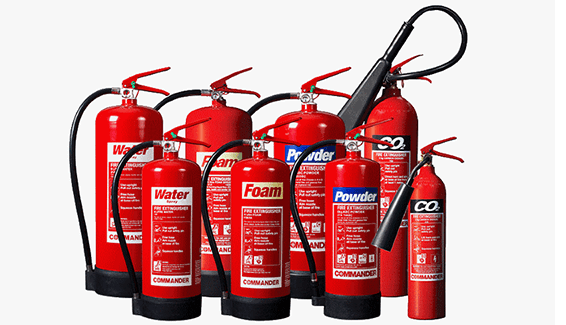





Powder and gas-based extinguishers (powder capsules)
These types of fire extinguishers are used to extinguish a wide range of fires and are commonly known as powder extinguishers. These equipment are divided into two categories: dry chemical extinguishers and wet chemical extinguishers.
Dry chemical extinguishers are used to extinguish Class D metal fires, while wet chemical extinguishers are used to extinguish Class A, B, and C fires. These extinguishers are used not only in residential and commercial environments, but also in factories and industrial workshops. In addition to being an alternative to water extinguishers, these equipment are suitable for extinguishing fires caused by flammable metal materials, flammable liquids, flammable gases, and electrical equipment.
In this method, determining the weight of the powder plays an important role in fire control, as the function of these extinguishers is based on smothering the fire surface. The following are examined in this process:
- Assessing the level of fire and its spread
- Preparing a map for the placement of manual extinguishers
- Determining fire density to determine fire load
- Measuring the area of a workshop or area where there is a possibility of fire.
- Determining the level of risk based on the type of use of the site
- Calculating the amount of powder required based on the formula K × S
- Determining the type of powder and its extinguishing factor, according to the quality, level of danger, and intensity of fire growth
- Estimating the number and type of extinguishers required, respecting a maximum distance of 30 meters to access them
CO₂ gas-based extinguishers
This group of extinguishers is used to control fires caused by flammable liquids, especially oils and electrical equipment. In this method, CO₂ gas extinguishes the fire by reducing the oxygen in the environment. Therefore, it is very important to calculate the approximate volume of the fire and the amount of carbon dioxide required. In these calculations, the following factors are taken into account:
- Determining fire density to assess fire load
- Calculating the probable area of the fire area
- Risk analysis based on location
- Estimating the maximum possible volume of a fire, taking into account the intensity of its spread.
- Calculating the total weight of the extinguisher required based on the estimated volume of the fire
- Specify the extinguishing factor, which varies between 0.68 and 1.5 kilograms per cubic meter.
- Determining the number and type of CO₂ extinguishers, respecting a maximum access distance of 30 meters
Foam-based extinguishers
These capsules are designed to suppress fires caused by flammable liquids. The function of these extinguishers is to prevent oxygen from reaching the surface of the burning liquid and, as a result, the fire is suppressed. The key point in using these equipment is to evenly distribute the foam over the flammable liquid to prevent further combustion. In this method, extinguishing is done by smothering the surface of the fire and the amount of foam required is calculated as follows:
V = (A / X) × K × 100
Where:
- V Amount of foam solution required in liters
- A Expected area for fire in square meters
- X نسبت توسعه کف (LOW EP>20, HIGH EP>200)
- K is the floor impact coefficient, between 1 and 1.5
Water extinguishers (water and gas)
These extinguishers are designed to fight small fires caused by simple materials such as wood and paper. However, it is important to note that they should never be used to extinguish fires caused by electrical equipment or oils. One of the challenges with these extinguishers is that they freeze at temperatures below 4°C. To provide the required pressure, CO₂ or nitrogen gas is used inside the cartridge of the extinguisher.
Bioversal extinguisher
These types of capsules are suitable for fighting fires caused by solids and flammable liquids such as paper, fabric, plastic, wood, oils, diesel and thinner. A distinctive feature of these extinguishers is their environmental friendliness, as they do not cause any environmental damage. Other advantages of these capsules include the following:
- Non-corrosive
- Preventing flame backflow
- High efficiency in controlling large and severe fires
- Inactivation of the four factors of fire spread (oxygen, heat, fuel, chemical reactions)
Halogen extinguishers
These extinguishers were discontinued in 1994 due to the damaging effects of halogenated compounds (such as 1211, 2402, and 1301) on the ozone layer. These capsules were used in the past to extinguish class B and C fires, as they did not damage electronic equipment. Today, alternative compounds such as Halotron and FE-36 are used as alternatives to these extinguishers, with similar performance and without the harmful environmental effects.