 Imen Datis Asia Co

 Imen Datis Asia Co
Types of fire hydrants: they are among the fire equipments that have an important role in fire extinguishing systems, welcome! We have prepared a selection of high quality fire hydrants for you, each with unique features and capabilities to meet your needs.
Guaranteed quality, strength, and the trust you will have in us, we are the right choice for your fire hydrants. Your security is of utmost importance.
Imen Datis Asia Technical and Engineering Company is the official representative of safex fire hydrants with international approvals and firefighting organization.



Fire butterfly valves, also known as wafer valves, are one of the vital equipments in fire extinguishing systems. These valves are used to adjust or cut off the water flow in the fire extinguishing pipelines by using a simple internal disk rotation mechanism.
In the following, some of the basic uses of the fire-fighting butterfly valve are mentioned:
Due to the ability to open and close quickly and easily, butterfly valves play a key role in isolating damaged or defective parts of the fire extinguishing system. This feature is especially important when there is a fire or when performing system repairs and inspections. By using these valves, it is possible to stop the flow of water in a certain part and prevent water loss or damage to other parts of the system, such as the fire pump booster.
The rotating mechanism of butterfly valves allows precise and gradual regulation of water flow. This feature is very effective and practical especially when there is a need for precise control of water volume and pressure for fire extinguishing, such as in sprinkler systems.
Butterfly valves are designed and produced in various sizes and dimensions and are used for various applications in fire extinguishing piping systems. Among the important uses of these valves, the following can be mentioned:
Water flow management in the main piping lines: Large butterfly valves are installed at the beginning of the main lines and allow the operator to completely control or stop the flow of water entering the system.
Separation of damaged parts: In case of leakage or problem in a part of the piping system, butterfly valves are used to isolate that part and prevent water wastage and spread of fire.
Regulating the flow of water to the fire nozzles: in the way of the secondary pipes that lead to the fire nozzles, smaller butterfly valves are used to precisely control the amount of water sprinkled and direct the flow towards the fire.
Also, these valves play a role in automatic fire alarm and extinguishing systems and can be opened or closed automatically by electric commands and adjust the water flow.
In general, fire-fighting butterfly valves, as one of the main components of the fire extinguishing system, play a vital role in controlling and directing the flow of water. The precise and reliable operation of these valves is very effective in controlling fires and reducing human and financial losses.

The use of fire gate valves or gate valves is usually used in key points of fire fighting systems, such as connecting to main water lines and networks, protecting buildings and other sensitive points. These valves provide the possibility of separating and isolating different parts of the system so that when an accident occurs, the spread of fire can be quickly and accurately prevented and the water flow can be managed in emergency situations.
Gate valves are designed and manufactured according to UL listed approved standards. All products are approved by UL/FM and Tehran Fire Organization and manufactured by Safex Fire Company.
Imen Datis Asia Technical and Engineering Company provides sales, installation and commissioning services, and after-sales technical support for all types of firefighting and water supply equipment throughout the country, using expert and trained staff.


The use of fire gate valves or gate valves is usually in the main points of fire systems, such as connecting to main water lines and networks, protecting buildings or other critical points, and making it possible to isolate different parts of the system.
The use of fire gate valves or gate valves is usually used in key points of fire fighting systems, such as connecting to main water lines and networks, protecting buildings and other sensitive points. These valves provide the possibility of separating and isolating different parts of the system so that when an accident occurs, the spread of fire can be quickly and accurately prevented and the water flow can be managed in emergency situations.
Gate valves are designed and manufactured in accordance with *UL listed* approved standards. All products are approved by *UL/FM* and Tehran Fire Organization and manufactured by *Safex Fire* Company.
Imen Datis Asia Technical and Engineering Company provides sales, installation and commissioning services, and after-sales technical support for all types of firefighting and water supply equipment throughout the country, using expert and trained staff.
It is used in case of an accident. It is possible to isolate with the help of gate valves quickly and accurately to prevent the spread of fire or to control the flow of water when necessary.
Gate valves are designed, manufactured and used based on UL listed approval. All products have UL/FM approval, Tehran Fire Department and made by safex fire company is
Imen Datis Asia Technical and Engineering Company provides all sales, installation and commissioning services, after-sales services of all types of firefighting and water supply equipment in the country with expert and trained staff.

This type of valve is divided into two main categories: standing fire valve (surface hydrant) and underground fire valve (underground hydrant).
The standing fire hydrant, which is usually visible in red color in different parts of the city, is connected to the municipal water and sewage network, and in emergency situations such as fire, the fire brigade uses it to charge the water hoses. This type of milk is divided into two types, dry standing valve and more standing valve, based on the type of use.
In this type, the upper chamber of the valve is without water (dry) and its upper part is installed above the ground level. When the main valve is opened, water enters the dry pipe and flows. This type of valve has an automatic drain system that drains the water in the pipes after closing the valve. This model is suitable for cold areas, where there is a possibility of freezing, and the shock mechanism prevents water from escaping in emergency situations.
This model is also installed above ground level, but its chamber is always full of water. This valve does not have a main valve and each outlet is equipped with a control valve. This type of faucet is not suitable for cold areas that are at risk of freezing, and because it does not have a shock absorber mechanism, it cannot prevent the sudden release of water during an accident. The water in this valve is under pressure and to use it, it is enough to open the outlet valve.
This type of valve is installed completely underground in a special chamber and is equipped with a shut-off valve. This valve is supplied with a hose and a hose base, and its connection type is flange.
A fire hydrant is a type of fire extinguishing equipment that is installed in different places so that when a fire occurs, the fire brigade can connect their hoses to the main valve to receive water. This valve is directly connected to the area’s water supply and is installed in places such as industries, mines, schools, roads and commercial parking lots so that firefighters can use water to fight the fire when necessary.
The body of fire valves consists of four main parts, which are: the upper cap, the middle body on the ground, the middle body under the ground and the lower body. Each of these sections is as follows:

It is mandatory to use the zone control valve package on the lines branching from the riser of the sprinkler system in the floors of the places that have several extinguishing zones. According to the division of buildings based on the height and area of the infrastructure by the Engineering System Organization, the use of the valve control zone package in the occupations of S2 and S3 groups has been made mandatory according to the requirements of the Tehran Fire Department.


Imen Datis Asia Company, as one of the companies approved by the fire department, in addition to providing advice on obtaining fire department approval, import and supply of all types of fire equipment such as fire pumps, fire valves, and fire alarm and extinguishing equipment from the best and most reliable brands. It is also in charge of internal and external. In this regard, Imen Datis Asia Technical and Engineering Company has the official representative of fire extinguishers with Safex Fire brand in Iran.

Flanged one-way valves are widely used in various industries. These valves are used in the oil and gas industry to prevent the return of oil and gas flow in pipelines, in the chemical industry to protect equipment against the return of chemicals, in water and sewage systems to prevent the return of sewage water and maintain water quality, and in Food and pharmaceutical industries are used to ensure the quality and purity of products by preventing backflow.
A one-way fire hydrant is a type of valve that only allows water to flow in one direction. In other words, this valve only allows water to flow in one direction and is locked in the opposite direction to prevent water from flowing. In firefighting systems, these types of valves are especially useful when the reverse flow of water in firefighting pipes must be prevented. For example, if water needs to flow only to the fire lines and prevent backflow, a one-way valve can be used.
The use of one-way valves to control the flow of water and prevent water from returning to other sources is vital in firefighting systems, and due to their one-way operation, they can help in emergencies and prevent fire accidents.
Imen Datis Asia Engineering Company is engaged in the import of one-way valves (CHECK VALVE) with UL/FM approval and is the exclusive agent for the sale and after-sales service of Safex Fire brand one-way valves, made in India.
One-way fire fighting valve or check valve is one of the most important and widely used valves in various industries. This valve prevents the return of water flow by using a simple mechanism. The one-way valve allows the fluid to pass in one direction and prevents it from passing if the flow reverses. The operation of this valve is automatic and does not require a lever or operator handle. The direction of fluid flow is also engraved on the one-way valve body. These valves are used in fire extinguishing systems, especially in the initial parts of the automatic sprinkler network, tanks and piping of fire pumps or before the Siamese valve. For easier identification, one-way valves in fire extinguishing systems are red in color and are mainly swing disc type. These valves are produced and supplied in various sizes.

The one-way fire alarm valve with double check valve and grooved design is designed to ensure positive water flow for alarm operation and is suitable for installation in pipe sprinkler systems. Its external bypass system prevents false alarms in different conditions of supplied pressures.
High-pressure water flows in firefighting pipelines that are connected in parallel to sprinklers, fireboxes, hydrants, and other equipment. In case of failure of one of the sprinklers or opening of the firebox valve, the water pressure in the pipe decreases and the pump is activated to compensate for this pressure drop.
By making the water flow in the pipe, the diaphragm on the body of the warning valve (wet alarm valve) which is located after the pump, opens and allows the water under pressure to flow in the ducts built into the body of the valve in addition to the extinguishing pipe. find The water flowing in these holes is directed to the retard chamber.
If the flow rate of the inlet water is less than the specified limit, the water will exit from the drain valve installed on the retard chamber, which indicates the water leakage from the holes and the incomplete function of the body. But if the water flow rate is higher, it means the opening of the diaphragm and the flow of water in the pipeline, and the retard chamber is filled in 15 to 25 seconds. After that, high-pressure water enters the notification system (water gong and pressure switch).
The entry of high-pressure water into the notification system immediately activates the mechanical alarm in the engine room, and by increasing the pressure in the pressure switch and activating it, the alarm can be sounded electronically in other places as well.


Before examining how this system works, it is important to know its components:
The body of the alarm system (Body): The body of the alarm system, which is usually installed after the pump, has a diaphragm that acts as a one-way valve. The difference between this body and the normal one-way valve is that there are small holes in the seat of the diaphragm. When the diaphragm is closed, these cavities are disconnected from the pressure source and the flow inside them is stopped. Instead, when the pump is turned on and the diaphragm opens, water flows into the cavities.
Water Gong: A water gong is a mechanical bell that creates a circular motion when a high-pressure stream of water strikes its blades. This rotational movement causes a bell to ring the body and produce an audible alarm at each revolution.
Pressure Switch: A pressure switch is a switch that turns off and on the flow of an electric circuit based on the pressure of the fluid inside the pipe. By increasing the pressure to a certain amount, the pressure switch can trigger an alarm in the floors by creating a short circuit in the electrical circuit.
Retard Chamber: Retard Chamber is a special chamber designed to prevent quick and wrong reaction of the alarm system. This chamber holds a certain amount of water and only after it is filled, the water enters the alarm system. To prevent the chamber from filling due to water leakage, the retard chamber is equipped with a small diameter drain valve.

There are three main types of fire fittings that are used to provide the water needed to extinguish a fire: the regular hydrant, the standing hydrant, and the flat hydrant.
Exposed Fire Department Connection
These types of valves, which are widely used, are installed on the outer walls of the building. In this design, the body, inlets and swivels are clearly and accessible to firefighters.
Freestanding Fire Department Connection
This type of valve is also exposed independently and is usually far from the wall of the building. Standing Siamese hydrants are connected to the building system through a ground pipe and provide a convenient access point for firefighters.
Flush Fire Department Connection
These types of fittings are installed on the walls of the building and only the couplings or swivels are clearly visible. The body and outputs are hidden behind the wall and under the cover of an identification plate. A flat Siamese faucet looks more aesthetically pleasing, especially when the building requires more entrances.
Fire hydrants are usually installed on the exterior of the building they protect. Some of these taps, which are placed independently of the building, are known as “stand-alone Siamese taps” or “pedestrian Siamese taps”. According to NFPA 13, these valves must be installed on the side of the building that faces the street. However, these valves may need to be installed on the side of the building that corresponds to its address.
However, it may not always be practical to install Siamese valves in all buildings such as shopping malls or stores. In such cases, the fire department or relevant regulations will determine the appropriate place to install the Siamese valve.
In addition to the installation location, Siamese valves should be marked with a sign indicating the type of supply system, the amount of water pressure required, and whether it is only for a specific part of the building (for example, a sprinkler system or a standpipe).
The Siamese fire hydrant inlet is connected to the dry or combined fire stand pipe and these valves can transfer excess water to the sprinkler system by connecting to the fire engine hose. In this way, firefighters will be sure of having enough water for extinguishing operations when extinguishing the fire. Siamese valves are usually made of a metal body with a rustproof coating and painted, and are usually coated with electrostatic paint to increase their resistance to corrosion and wear.

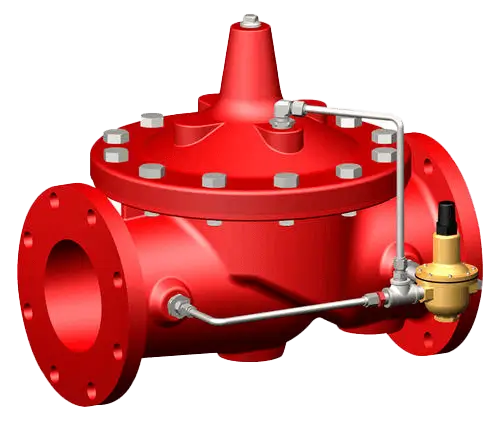
Firefighting pressure reducing valve or pressure reducing valve (Pressure Reducing Valve – PRV) plays a key role in fire extinguishing systems. These valves are designed to reduce and control water pressure in firefighting systems and prevent dangerous pressure increases for pipes, fittings and firefighting equipment. By using these valves, the pressure of the water entering the system is reduced to a safe and suitable level so that in case of fire, water can be transferred to the required points with the appropriate pressure.
The features of the fire-fighting pressure relief valve include the following:
Pressure reducer: The most important function of these valves is to reduce the pressure of water entering the firefighting system to provide proper pressure for sprinklers and other firefighting equipment.
Adjustable: Many PRVs are adjustable, allowing users to precisely set the desired pressure.
Resistance to shocks and sudden pressures: These valves must be able to withstand sudden pressures that may occur due to unexpected connection to the water network.
Accurate pressure control: PRVs must be able to accurately control pressure so that the desired pressure remains constant over time.
Compliance with standards: These valves must comply with standards for firefighting systems, such as NFPA 13.
Pressure relief valves are very important in firefighting systems; Because proper water pressure in sprinklers and other equipment is critical to their proper operation. High water pressure may lead to the failure of pipes or fittings and excessive water leakage, which can lead to equipment damage and building destruction.
In fact, PRVs act as one of the main components in fire protection and pressure control in firefighting systems.

Firefighting pressure relief valves are divided into two main categories: mechanical and pilot.
Safety valves reduce the excess pressure in the system by passing the pressurized fluid through a side path. These valves are designed and adjusted to activate at a predetermined pressure and protect pressurized equipment such as tanks from overpressure.
By adjusting the pressure on the pilot, the pressure relief valve is able to automatically reduce the output pressure and keep it constant. This setting is such that changes in flow and inlet pressure do not affect the outlet pressure.
Types of pressure relief valves include:
The applications of pressure relief valves are:

A vent valve or air vent, which functions similarly to a thermostat, is commonly used to vent steam and air from systems. These valves are able to release the accumulated air in the pipelines under pressure and also in the situation when the pressure inside the pipe decreases, they can return the air to the system. The main application of this system is in water and air piping.
Air release valves are installed vertically above the pipelines. These industrial valves have an opening in the upper part for air in and out, and there is a float inside them. When there is no liquid fluid in the valve, the float is at its lowest point, allowing air to escape through the top opening. As the liquid level inside the valve increases, the float rises and as soon as it reaches the highest point, it blocks the air outlet and prevents the liquid from leaving. As more air accumulates, the float moves back down and the air is expelled, then the float rises again and closes the orifice. This process is repeated continuously.
When the pipeline is emptied or a pressure drop occurs due to problems such as pump failure, the liquid fluid is transferred to the lower parts of the pipeline and a vacuum is created in the upper parts. This situation can be harmful at high pressures, but the presence of an air release valve in the pipeline prevents this problem from occurring. As the liquid level drops and vacuum is created, the float is lowered and the air hole is opened so that air enters the pipeline and compensates for the vacuum.
In some models of air discharge valves, a disk is used instead of a float, which is responsible for controlling the entry and exit of air.
Air releasing valve is one of the safety equipment designed to prevent problems caused by gas and air accumulation in water piping systems. This valve, which operates automatically, helps vent air from water pipes and is commonly used to vent steam and air.
In the process of moving fluids in fluid line systems, some air or other gases move along with the fluid. This air can disrupt the correct flow of fluid, cause corrosion in equipment, reduce the efficiency of pumps, or prevent the system from being completely filled. Therefore, this air must be quickly removed from the system, which is done automatically by the air drain valve or air vent.
The main purpose of the air release valve is to remove the air in the pipes and various components of the system to control problems such as increased pressure, reduced system efficiency, and water loss.

Fire extinguishing systems that operate with water or foam require a main valve that can open the fluid flow path at a high speed in the shortest possible time to start the extinguishing operation.
This key task is the deluge valve.
The deluge valve is designed to discharge large volumes of water in large areas in a relatively short period of time. Deluge Valve systems usually do not take up much space and come with pre-installed equipment, which reduces installation time and simplifies the installation process.
Tiara’s safe flood valve opens quickly and smoothly to prevent ram shock.
The deluge valve. opens quickly and smoothly to prevent ram shock.
Function of flood valve:
Deloj R valve is opened and closed using its only moving part, i.e. reinforced rubber seal. This particular tire is known as a diaphragm.
Closed state: In this state, the water pressure behind the diaphragm (P1) is equal to the pressure of the main water flow (P2), which results in the closing of the flood valve.
Open state: When the water behind the diaphragm is discharged, its pressure is reduced and the main water inlet pressure causes the valve to suddenly open and the water flows in a flood.

1- Reliable operation, due to the absence of moving mechanical parts.
2- Resistant to ram impact, with the ability to open and close the valve quickly.
3- Sufficiency of atmospheric pressure to close the valve completely. (Even if the pump is out of order and the system is not under pressure.)
4- Ability to adjust opening and closing speed.
5- Ability to carry pre-assembled.
6- The possibility of horizontal and vertical installation.
7- Quick and easy setup.
8- The ability to stimulate the milk from a distance.
9- Compact design for limited spaces.
10- Ability to produce up to 21 bar working pressure.
11- Ability to build with various coatings.
12- Variety in the selection of milk raw materials (according to working conditions).
13- The possibility of adding new mechanisms to control the output pressure, etc. by making changes in the command circuit.
14- Easy maintenance.

Pre-actuator systems are divided into three main categories based on how the fire detection system and sprinklers interact with the pre-actuator valve: [NFPA 13, 2019: 8.3.2.1]
Pre-actuator systems with single interlocking (Single Interlock System):
In this system, the pre-actuator valve works only when the fire detection system is activated, and the opening of the sprinklers does not affect it. That way, if the sprinklers are opened due to problems other than fire, such as physical damage, the pilot valve remains closed and does not allow water to drain. Also, if the fire detection system is activated by mistake, the water will only travel to the back of the sprinklers and will not drain into the area because the sprinklers are closed. This type of system is used to ensure that water is discharged only in the event of a fire in places such as electrical and computer rooms where splashing water would cause damage. Also, this system works faster than the dry pipe sprinkler system and can be used as a suitable alternative to the dry pipe system. The deluge valve can be used as a valve of the single joint pre-actuator system.
Pre-operator systems without interlocking (Non-Interlock System):
In this type of system, the activation of any of the fire detection or sprinkler systems causes the opening of the pre-actuator valve. The non-bonded pre-actuator system is more sensitive than the single-bonded system because the system is activated only when the sprinkler is opened and there is no need to wait for the fire detection system to activate. This system can be used as a suitable alternative to dry pipe sprinkler systems in cases where more certainty is needed to activate the valve.
Pre-actuator systems with double interlock system:
To activate the pre-actuator valve in this system, both the fire detection system and the sprinkler must be activated at the same time. Due to the need to depressurize and vent air in the pipes after activation of the double interlock system, this system operates similar to a dry pipe system in terms of drain time and must meet the requirements of a dry pipe sprinkler system, including the requirements Regarding the size of the system and the time of draining the water from the test connection, it should be observed. This type of system is used in places where there is a need to prevent water from entering the piping network, except in emergency situations. One of the common uses of this system is in cold storages below zero degrees. For example, the temperature of cold storage used for food storage may reach -12°C or less. In this situation, water entering the pipes can cause them to freeze quickly, and the only possible solution is to disconnect the pipes from the system, completely drain and dry them, and then reinstall them.
AGCX model pre-actuator hydraulic valve is designed for water sensitive areas that need protection against excessive water flow in sprinkler systems.
This deluge valve works hydraulically, and the water entering the pre-actuator system is controlled through the Clapper.
In deluge systems, open nozzles are used as discharge points during a fire, while in pre-actuator systems closed nozzles or sprinklers are used.
Both systems use separate detectors to control Deluge Valve operation. The AGCX drain valve can be reset from the outside without removing the cover.
This adjustment is done by pushing back and turning the external reset knob on the back of the Deluge Valve.

Post indicator valve, also known as fire line isolation valve, is one of the key components in fire fighting systems. This valve is mainly used to isolate different parts of the fire line.
In a fire water network in industrial environments or factories, there are usually several different branches, each dedicated to a specific service of the fire system. For example, a factory may use sprinkler systems, foam, etc. for different areas. Each of these systems is connected to separate branches of the fire water line.
Due to the fact that leaks or failures may occur in the fire fighting system, it is necessary to install an isolation valve or indicator post in the exit path of each branch. This valve is designed to facilitate maintenance, so that repairs can be performed without the need to disable the entire system, just by closing the valve of the desired line.
The post indicator valve is usually installed underground and is driven to the ground using a lever that is used to open and close the valve. In addition to being installed on fire lines, these valves are also used before hydrants. The dimensions of the indicator post valve vary according to the depth of burial and the size of the fire line, and there may be differences in each industrial environment.


Post-indicator valves for firefighting systems are produced in various models, including models with and without indicators. In indicator models, there is a glass valve on top of the valve that shows the open or closed status of the valve after using the operating lever. On the other hand, models without indicators can only be opened and closed using a lever, and it is not possible to control the status of the valve.
In models with indicators, the lever and indicator are usually installed at a distance of about one meter from the ground. To open the valve, the operator must put a special wrench on the indicator screw and turn the screw to open or close the valve. The valve indicator shows whether the valve is open or closed according to the position of the valve.
On models without indicators, the operator can open or close the valve from a level above the burial depth (ground level) by turning the valve lever. But to control whether the valve is open or closed, it is necessary to do this manually.
These valves are a type of isolated gate valve that are installed along the fire line. An indicator or post plate is installed on these gate valves, which is used to open and close the valve from the ground level. The gate valves used in post indicator valves are of non-rising stem type so that the level of the operating lever does not change during operation.
In dry pipe fire sprinkler system, water control is done automatically through one or more sprinklers. In addition to controlling the water, the DPV model 1-dry pipe valve also activates the fire alarm in the system.
Features of this valve include a unique design that makes it easier to install and a lightweight cast iron construction that helps with easier transportation and lower costs. Also, this valve has a variety of inlet and outlet connections.
Imen Datis Asia Company, which is approved by the fire organization, in addition to providing advice for obtaining fire approval, as an importer and supplier of all types of firefighting equipment, including fire pumps, fire valves, and fire alarm and extinguishing equipment from the best domestic and foreign brands. operates This company is also the official representative of Safex Fire brand fire valves in Iran.
For more information and price inquiries, please contact our experts.
The dry pipe valve of the sprinkler system (Dry Pipe Valve) is used as the controller of the dry sprinkler system. In this system, the water pressure at the inlet and the air or nitrogen pressure at the top of the valve reach a balance and close the valve. When the sprinklers are activated in the protected environment, the air flow is discharged and the pressure balance between the two sides of the valve is disturbed. This pressure change causes the milk powder to open.
Like wet milk, dry milk also sends a signal to the central fire alarm system after being activated.
To fill the air line between the milk powder and the sprinklers, it is necessary to use auxiliary equipment such as an air compressor and air flow equalizer (AMD).
After each operation, to restart and put the valve in service, it is necessary to open the inspection valve and reset the valve using a special wrench.
Frequently asked questions
The price of fire hydrants may vary greatly depending on their type, size, and technical features. Buying fire hydrants are usually available in different price ranges. Also, the cost of purchasing fire hydrants may depend on factors such as brand, quality, features, size and place of purchase. To get the most accurate information about prices, contact our experts at Imen Datis Asia Technical and Engineering Company.
Ayman Datis Asia Technical and Engineering Department is a supplier of all kinds of fire fighting valves from the best domestic and foreign brands. It should be noted that Imen Datis Asia is the official supplier and representative of Safex Fire valves in Iran, which is also approved by the fire department. Contact us for more information and to inquire about availability and price.
To choose the most suitable and best fire hydrant from the most reliable domestic and foreign brands of Safex Fire, please contact Ayman Datis Asia experts for a comprehensive and complete consultation to choose the best valves according to the needs of the project and its required technical specifications. provide
Installing fire hydrants is an important and complex process that requires careful planning, appropriate equipment and technical expertise. At each stage of this process, special importance is given to safety and quality standards so that the fire hydrant is installed correctly and with optimal performance and, if necessary, works properly in emergency situations. Our technical experts at Ayman Datis Asia Technical and Engineering Company are ready to serve our valued customers.


